I recently entered the following prompt into Perplexity.AI: “When schools implement Social & Emotional Learning (SEL), how come school districts have to hire more staff?” It responded:
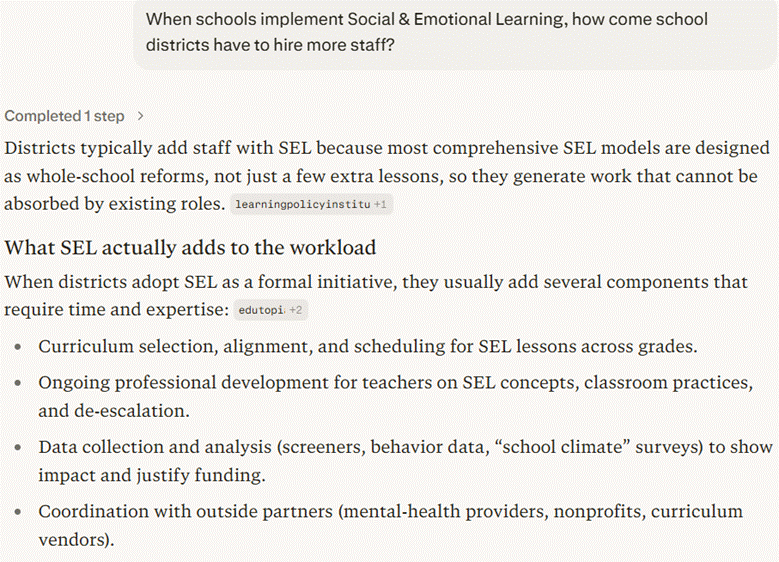
It also mentioned that districts typically create additional positions, such as director of wellness, and often hire counselors, social workers, and psychologists to handle rising referrals for anxiety, behavior, and crisis framed as SEL needs.
You can read the full AI response here.
Rather than focus on academics, SEL focuses on the “whole child”. The “whole child” approach is not constrained to traditional classroom concerns and instead branches off into all aspects of a child’s well-being, including mental health, emotional health, and physical health. These extra engagements require more staff. The 2017 Michigan Department of Education (MDE) Early Childhood to Grade 12 Social and Emotional Learning (SEL) Competencies and Indicators publication states, “In combination with the Michigan Health Education Standards, SEL competencies help support a well-rounded education that teaches to the whole child. When caregivers and schools focus on the development of the whole child, utilizing SEL competencies to guide instruction and interactions with children and students, academic achievement improves, as well as the skills needed for college and career readiness.”
The MDE SEL Competencies refers to “guidelines for creating school climate,” “preparing students for the global future,” “equity,” “diverse communities,” and “culturally sensitive instruction.” Referring to Content Standards (CS) that the MDE adopted in 2010, it states, “SEL is implicit throughout CS (content standards).” Additionally, it states that “since 2008, MDE has offered various buildings, districts, and Intermediate School Districts professional development around school mental health strategies for teachers, including SEL.”
Jeff Myers from Save Oregon Schools compiled a database that generates graphs showing the Student Enrollment and Staffing trends for US school districts between 1992 and 2024. The increase in non-teaching staff at Grand Haven Area Public Schools (GHAPS) correlates with the implementation of SEL. Although there was an increase in the proportion of staff to students for the time period of 1992-2011, the ratio stayed relatively stable with a student population increase between 4-6% and a staff increase of about 18%. Then in 2011 there was a significant jump in non-teaching staff which has continued to trend upwards despite a significant decline in student population which began in 2015.
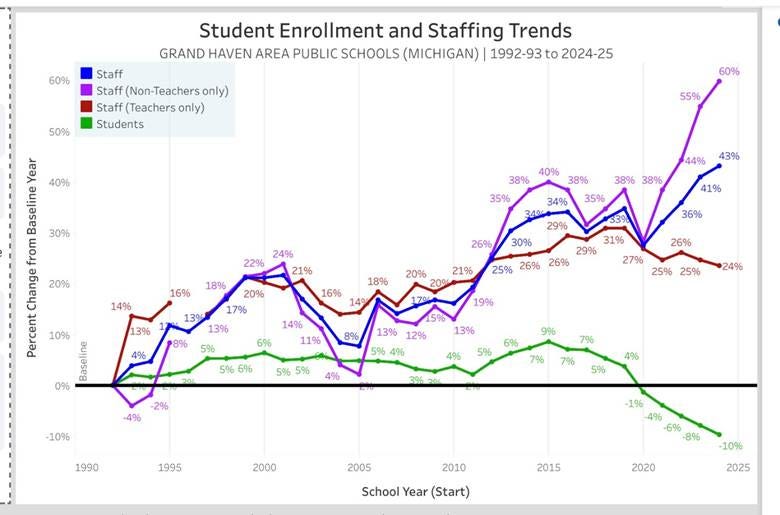
It appears to us that after 2011 is roughly the time period when GHAPS began obediently following the MDE guidelines to implement SEL. In 2020 for example, GHAPS provided families of Young Fives and Kindergarten students with SEL lessons from the Conscious Discipline curriculum that introduced children to “I love you” rituals, where they learned gestures and sang alternative lyrics to classic children’s songs such as Twinkle, Twinkle, Little Star, and Peter, Peter, Pumpkin Eater. Older students were subjected to SEL generative them lessons during academy class. A generative theme is an emotional topic that has political undertones, which an activist teacher can use to engage a class. Conversely to what is claimed by the MDE SEL experts, these SEL lessons shift the focus away from academics, lowering test scores and preparing kids to be more receptive to collectivist ideology and big government.
The response from Perplexity.AI also highlighted the impact of data collection on staffing. “Once a district buys SEL screeners or climate surveys, someone must administer them, interpret data, and follow up with students.” Restore Ottawa previously wrote about how SEL uses the results of data collection to manipulate student emotions to induce certain societal behaviors, and shape the way children see the world through the use of reward and behavioral support systems such as Multi-tiered system of supports (MTSS) and Positive Behavior Interventions and Supports (PBIS). GHAPS has been continuously implementing these types of programs which require additional staff. SEL data is also used for mental health related referrals, and to justify additional training for teachers. Data is collected in various ways including daily wellness checks, surveys of students, staff, and parents, and continuous testing. According to Perplexity.AI, “In practice, SEL implementation becomes a vehicle to justify and fund more mental-health and climate staff, rather than just a pedagogical tweak in existing classrooms.”
Data collection continues under the cover of “security.” During the March 2026 GHAPS Board of Education meeting, Director of Safety and Security Trent Carruthers informed the board of upcoming mandatory requirements for tracking behavior due to the Michigan Behavioral Threat Assessment Management law.
While schools should place an emphasis on identifying true threats to safety, GHAPS parents have complained the behavior tracking has gone too far. They say their children are receiving notes in their permanent files for normal childhood behaviors. For example, when elementary boys discussed whether they wanted to “kiss, kill, or marry” various girls in their class, rather than receive a simple verbal reprimand from a teacher that their game was inappropriate, parents received formal notification of behavior citations they were required to sign and return to the school.
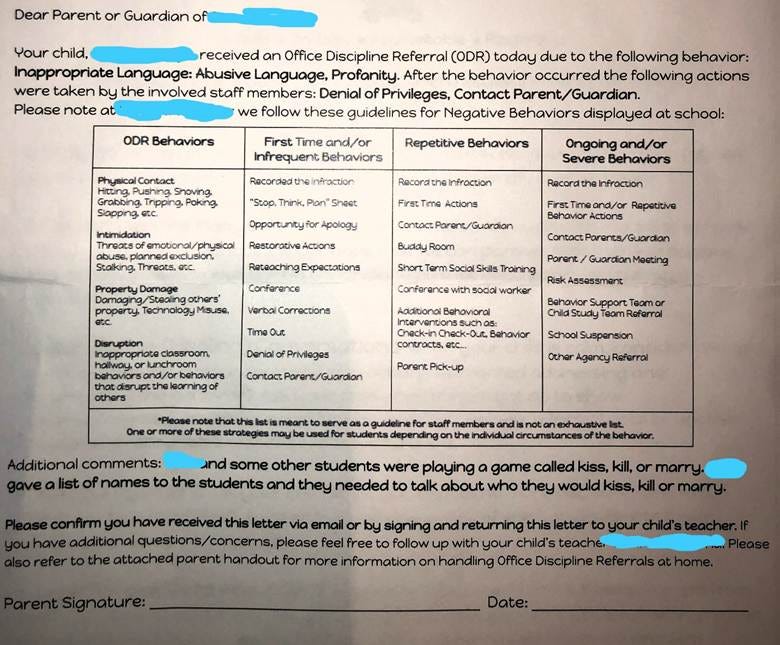
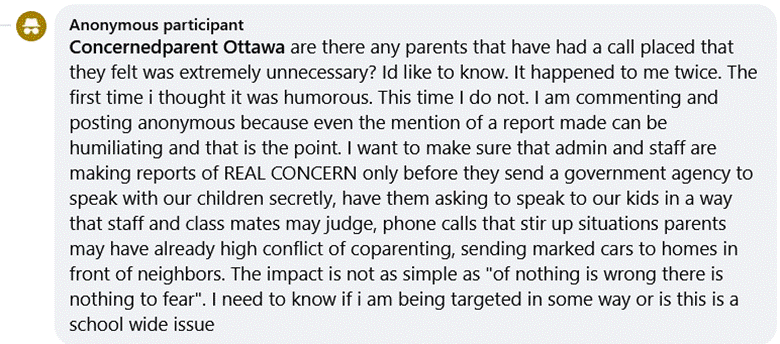
Not only is the increased effort more time consuming for staff, parents are confused by the tracking of normal behaviors, and are reaching out on social media.
Over the same time period that SEL has been implemented and non-teaching staff has dramatically increased, the use of technology in the classroom was introduced. In 2014 GHAPS voters approved an $18.9 million technology bond which was used to purchase Chromebooks for all students.
The MDE SEL Competencies mentioned above further states, “Within the child’s natural environment and/or school setting, SEL can best be accomplished through a layered approach of skills lessons taught through the curriculum and infused into the environment including safety, respect, and caring.” The use of online curriculum greatly facilitates providing students with SEL infused lessons as content is created by a limited number of large corporations and pumped out to students via their screens.
Voters were led to believe that the introduction of technology would make learning more efficient and better, but things haven’t worked out that way. Due to continued poor academic proficiency, in 2023 GHAPS once again turned towards technology and hired virtual tutors. The increased efficiency of technology should have reduced the need for staff, but instead the number of non-teaching staff skyrocketed after students were given Chromebooks.
In theory, both the adaption of technology and implementation of SEL should have improved student performance, but the data tells a different story. In fact, the transformation to SEL in public education has resulted in steadily declining academic proficiency. SAT scores are just one data point that shows the downward trend.
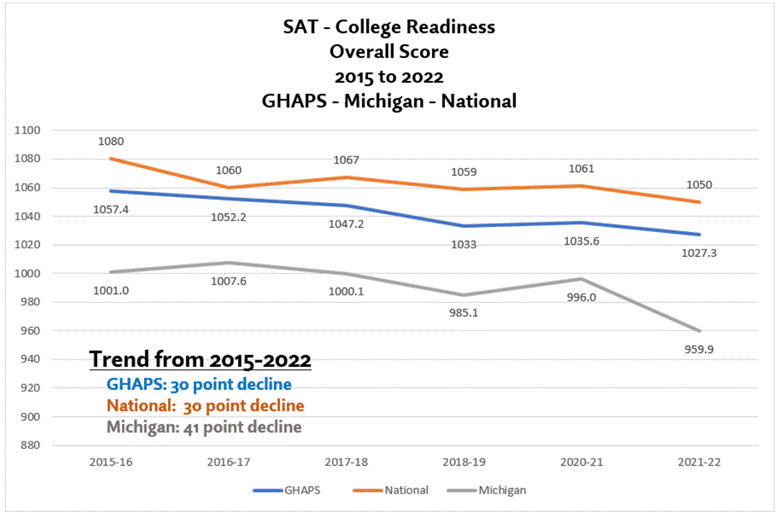
As SEL has been implemented, many school lessons have moved online, the non-teaching staff to student ratio has dramatically increased, and academic performance has suffered. Behavior tracking and data collection have intensified. Mental stability of students has decreased as rates of anxiety and depression have increased. GHAPS administration has done a poor job of fulfilling its mandate to educate our children in the academic basics of reading, writing, and arithmetic, and have unquestioningly followed the recommendations of higher-level credentialed experts at the Michigan Department of Education. Perhaps GHAPS should return to a focus on academics while eliminating SEL programs and letting parents handle the emotional and spiritual needs of their children.